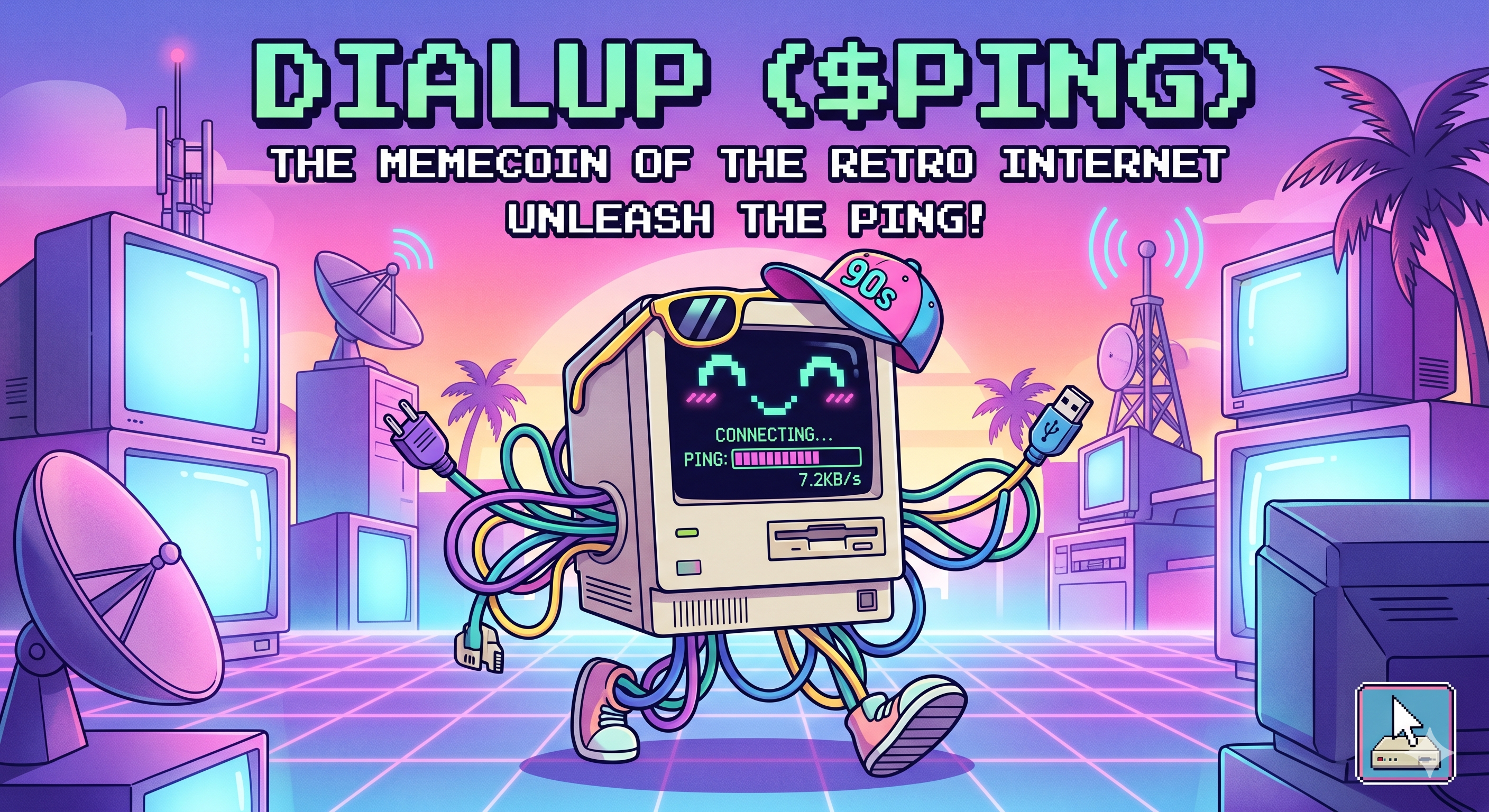
Before 5G, before 4K streaming, before real-time DeFi wallets — there was
an internet where every click was a gamble.
You plugged in the modem, closed the bedroom door, hoped nobody would pick up
the phone, and waited for that familiar sequence of screeching sounds.
It meant one thing:
You were online. And in that moment, the whole world felt possible.
Back then, PING wasn't just
a number in a terminal window. It was the heartbeat of your connection —
the proof that the digital world had answered your call. Low ping meant
the universe was listening. High ping meant buffering, lag, and patience.
But either way, you were there.
Napster was downloading in the background. mIRC was buzzing. Your ICQ
status was set to "Away" just to seem busy. Pages loaded line by line,
images revealed themselves pixel by pixel, and somehow —
it felt like magic.
$PING is a tribute to that era. And a signal for what comes next.
Why $PING Exists — Three Missions:
🖥️ Celebrate Internet Culture
Remember when forums, MSN Messenger, and Winamp skins were the internet?
$PING keeps that spirit alive — in memes, in community, in every transaction.
🔗 Bridge Community & Infrastructure
While Mining Hash builds the serious side — smart contracts, NFT miners,
$HASH distribution — $PING connects the human layer: culture, engagement,
nostalgia, and the people who still feel something when a modem dials.
📡 Be the Network's Heartbeat
Every $PING transaction is an echo reply — proof that the network is alive,
the community is connected, and the mission is still running. It's the
"packet" that says:
we're still here.
$PING vs $HASH — Two Sides of the Same Network:
$HASH
The fuel. Generated by NFT mining devices staked on-chain.
Represents the economic power and infrastructure of the ecosystem.
$PING
The signal. The sound that confirms the network is alive.
Represents culture, community, and the human side of Mining Hash.
"If you can still hear the dial-up noise in your head —
you're early enough for $PING."